
Harvard researchers identify potential eighth dwarf planet in outer solar system
The object, designated 2026 ED138, is likely 600 to 1,500 kilometers wide and was detected using the Vera C. Rubin Observatory in Chile.
By Claire Darwish ·
The International Astronomical Union established the dwarf planet category in the early 2000s after new large bodies were found beyond Neptune. On Tuesday, researchers from Harvard University announced the discovery of a new candidate that may belong to that class.
The object, provisionally named 2026 ED138, is estimated to have a diameter between 600 and 1,500 kilometers. Scientists described it as one of the brightest objects found in the solar system in decades. It ranks among the seven largest known objects in the outer regions of the solar system.
Matthew Holman, an astrophysicist at the Smithsonian Institution and a professor at Harvard, explained that the exact size is currently unknown. The team can only measure the amount of light reflected by the body. Therefore, the object could be a smaller body with a highly reflective surface or a larger body with a dark surface.
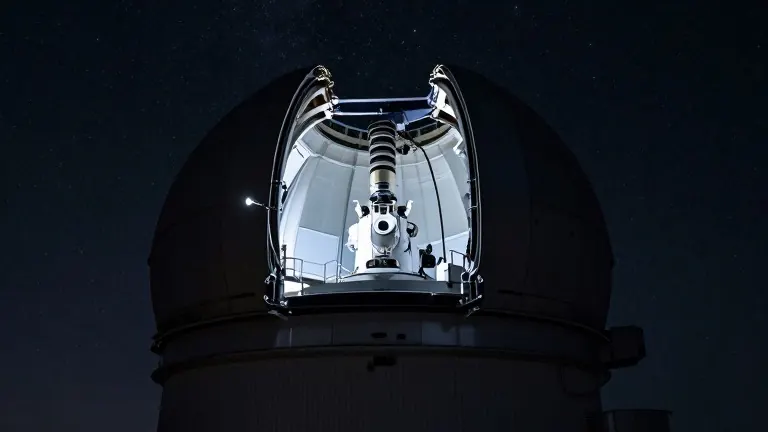
The discovery was announced at the 59th annual meeting of the Division for Planetary Sciences of the American Astronomical Society. The conference is taking place this week in Spokane, Washington. The team used the Vera C. Rubin Observatory in Chile to detect the object. The telescope features an eight-meter mirror and a wide field of view. It observes the entire visible sky from its location in Chile every three nights.
Kevin Napier, an astrophysicist at the Harvard and Smithsonian Center for Astrophysics, described the detection process as connecting points of moving objects. Once enough data points are gathered, researchers can calculate the object's approximate orbit around the Sun. The object had remained hidden because it is located in a bright region of the night sky, specifically the galactic center of the Milky Way.
Holman noted that the object is bright enough for amateur astronomers with high-quality equipment to see. This suggests that other large bodies may still be undiscovered. The new candidate joins thousands of known objects in the Kuiper Belt, a region beyond Neptune. Napier said that many dwarf planets move to distances three times farther than Neptune's orbit, making them much fainter and harder to detect.
Additional images from telescopes are required to confirm the object's size. Holman stated that determining the true dimensions will clarify whether the body meets the definition of a dwarf planet. The Vera C. Rubin Observatory will feature in a NOVA documentary titled Universe in Motion, scheduled for release on December 16.
Source: El Planeta