Hidden Love Letters Offer New Glimpse of Doomed La Pérouse Expedition
Rare personal letters from a scientist who sailed with the lost French expedition have resurfaced in a book of engravings and will go to auction in Paris on 17 November.
By Alexei Malhotra ·
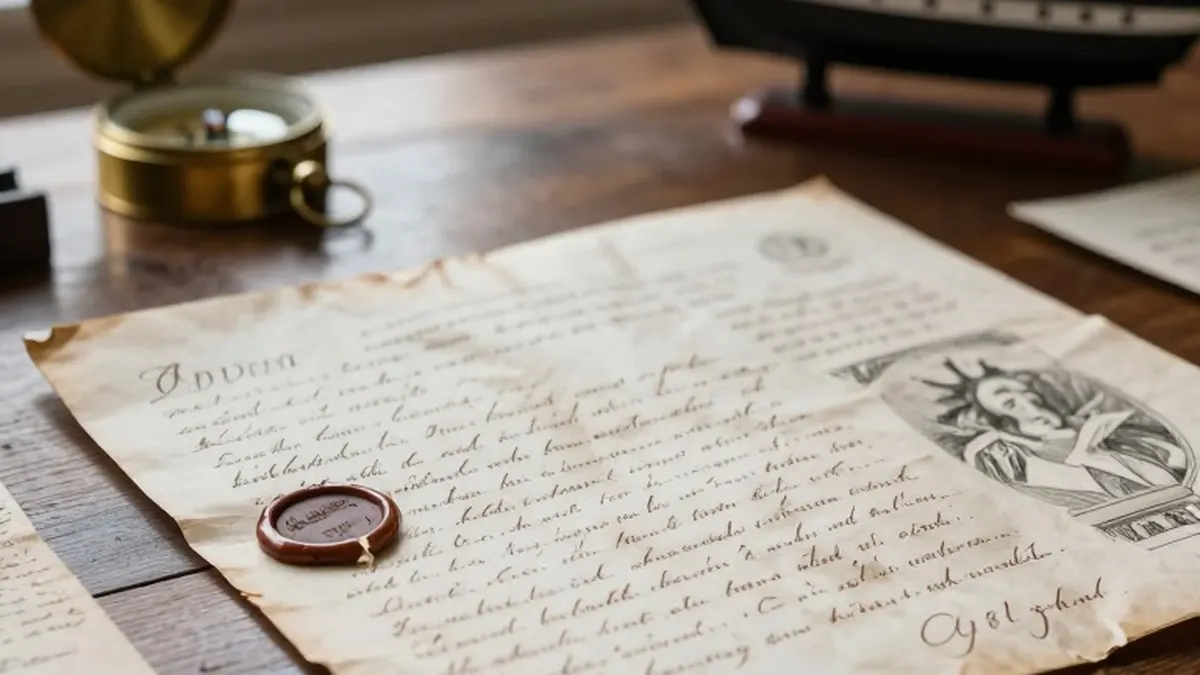
A set of rare letters written by a scientist aboard the ill-fated La Pérouse expedition has come to light in France, offering an intimate account of a voyage that ended in one of the great maritime mysteries of the 18th century. The letters were found tucked inside a book of engravings that was being prepared for sale.
The expedition was commissioned by Louis XVI, who in 1785 sent the naval officer Jean-François de Galaup, the count of Pérouse, on a round-the-world scientific mission meant to rival the discoveries of the English explorer Captain James Cook. Reports say that before his execution by guillotine on 21 January 1793, the king asked: "Is there news of Monsieur de la Pérouse?"
La Pérouse's two ships, La Boussole and L'Astrolabe, carried 225 crew, officers and scientists. They left Brest on France's Atlantic coast on 1 August 1785 and for almost three years sent back reports from stopovers including Alaska, California, Asia, Russia and Samoa, where the captain of the Astrolabe and 11 men were killed. The voyage came amid fierce Anglo-French rivalry over colonial expansion, and Louis XVI had political and trade ambitions as well as scientific ones.
The ships vanished after leaving Botany Bay in Australia in March 1788. La Pérouse had arrived there to find that Captain Arthur Phillip and Britain's First Fleet had beaten him to the coast by only six days. The vessels are believed to have foundered on coral reefs at Vanikoro, east of the Solomon Islands, during a tornado a few months later. Wreckage was found in 1826 and 1964, but the wrecks were only formally identified in 2005.
The newly surfaced letters were written by Jean-André Mongez, a scientist, church canon and director of a prominent science journal, who sailed with the expedition. They were addressed to Louise Victoire Le Cloustier, the married daughter of a minor noble family from Rouen in Normandy. Ludovic Miran, a book and manuscript expert at the auction house, called the discovery "a miracle". "We have a certain number of documents from the expedition but they are almost all scientific, so these personal letters are extremely rare," he said.
According to Miran, Mongez used the letters to voice his unhappiness over her marriage and seems to express regret for past behaviour. "He writes several times: 'I will be back, I will be another man, a better man,'" Miran said. He suggested this relationship may have helped drive Mongez's decision to join the perilous journey, though Mongez himself told her he was going partly for "the love of fame and the desire to acquire new knowledge".
The correspondence also describes how the young men endured three years at sea. Mongez recounts the massacre of a friend and others at one stop. In his last letter, he says the expedition has taken a sad turn and that he now only wants to return home, because such unhappiness is not compensated for by the meagre scientific results. "Perhaps it is a journey of redemption," Miran said.
Le Cloustier died in 1821, never knowing what became of Mongez or the expedition. Miran said the letters show signs of having been read and reread, and he imagined she had to hide them from her husband. Auctioneer Benoît Derouineau said he found them in an "unremarkable" 19th-century book of engravings. "They had clearly been carefully saved and hidden," he said. "But she hadn't thrown them away or burned them."
The letters are valued at €30,000 to €50,000 and will be sold as a single lot by Daguerre at the Hôtel Drouot in Paris on 17 November.
Source: The Guardian