Bronze Seal Ring Bearing Alexandria Lighthouse Image Found in Underwater Dig
Egyptian officials say the ring, recovered off the coast of modern Alexandria, is the first known seal ring engraved with the ancient Pharos.
By Claire Darwish ·
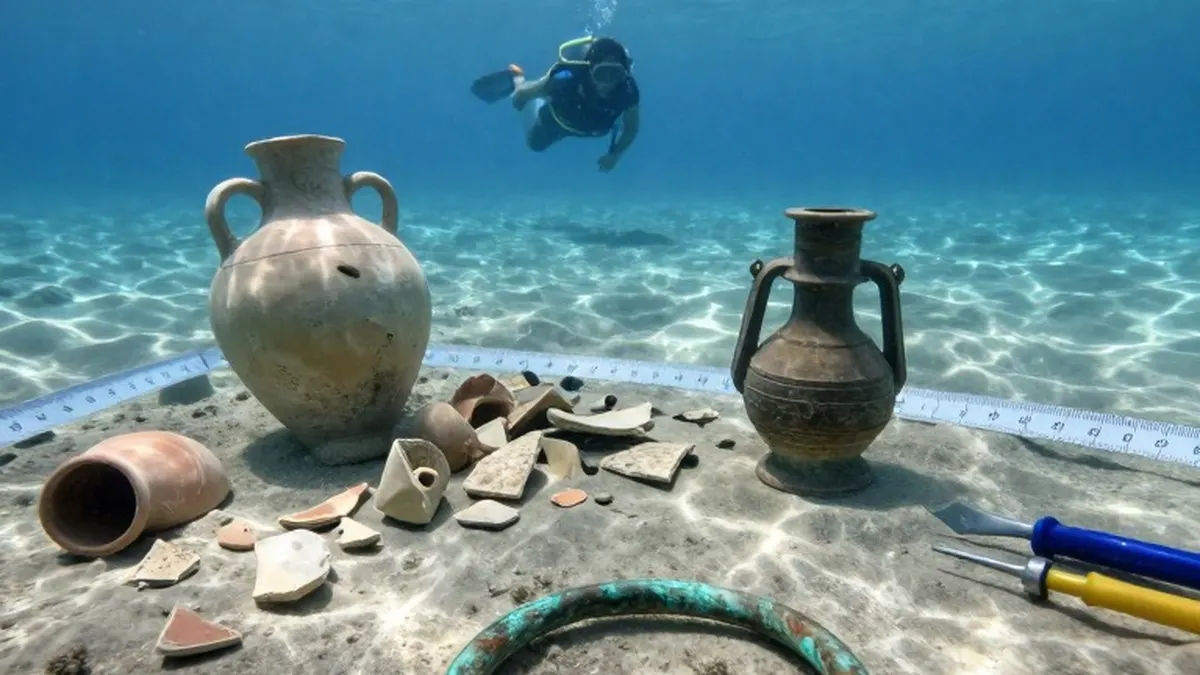
Archaeologists working underwater off the coast of Alexandria have recovered a bronze seal ring engraved with an image of the ancient Pharos lighthouse, Egypt's Tourism and Antiquities Ministry announced earlier this month.
The Pharos, counted among the Seven Wonders of the Ancient World, was constructed during the reign of Ptolemy II Philadelphus, who ruled from 280 to 247 BCE. It is thought to have risen at least 100 meters, which made it one of the tallest man-made structures of its era.
Earthquakes that struck between 956 CE and 1303 badly damaged the tower, and it was later abandoned. Its stones were eventually reused in 1480 to build the Citadel of Qaitbay. French archaeologists located remains of the lighthouse in 1994, and in 2025 parts of its threshold and foundation paving stones were brought to the surface to support a digital reconstruction of the site in Egypt.
The ring turned up at the former island of Antirhodos, which was once part of Alexandria's Portus Magnus, the ancient royal eastern harbor. The island held a Ptolemaic Egyptian palace. It is believed to have sunk around the 4th century CE, after an earthquake near Crete in 365 set off further quakes and a tsunami. The site now rests about five meters below the surface off modern Alexandria.
Hisham El-Leithy, secretary-general of the Supreme Council of Antiquities, said this is the first time an image of the ancient lighthouse has been found engraved on a seal ring. He suggested the depiction may show that the Antirhodos palace remained in use until the second century CE for administrative purposes, including matters tied to the lighthouse. The image resembles well-known portrayals of the structure on coins from the second century CE.
Franck Goddio, director of the European Institute for Underwater Archaeology, said the team has unearthed a range of other artifacts during the current season. These include pottery tableware, amphorae, flasks and oil lamps dating from the 4th century BCE to the 4th century CE, along with fragments of glass vessels from the same period.
Goddio noted that the excavations are focused on four locations in the eastern harbor area: the Temple of Isis, the palace site and western mound on the royal island of Antirhodos, the remains of the obelisk, and the Timonium, also known as "Antony's palace."
Egyptian Tourism and Antiquities Minister Sherif Fathy praised the mission for its discoveries, saying they help deepen understanding of Alexandria's history.
Source: The Jerusalem Post