Georgia's economy defies protest standoff
Tourist visits hit a record 5.5 million in 2025 while the nation marks two years of political unrest.
By Thiago Cruz ·
Tbilisi operates on a dual rhythm. On weekends, the city pulses with political dissent, while on weekdays it bustles with international commerce. This split reality has become the defining feature of Georgian life as the country enters its third year of crisis.
Monday marks the two-year anniversary of the parliamentary elections held on 26 October 2024. Those contested votes ignited a political storm that has not fully abated. Protests began two days after the poll and reached a fever pitch in late November. At that time, the government declared that opening European Union accession negotiations would not be an agenda item before the end of 2028. This decision angered many citizens who favor closer ties to Brussels.
The Georgian Dream party, which has held power since 2012, faces accusations of authoritarianism. Its suspension of EU accession talks in 2023, despite the country receiving candidate status that same year, deepened the divide. Critics argue this move signals a pivot back toward Moscow. The resulting standoff has created one of the longest sustained protest movements in recent history. Every Saturday, crowds gather in Avlabari Square in the Armenian quarter. They march toward the Bridge of Love and Freedom Square, chanting slogans against Prime Minister Irakli Kobakhidze.
Despite the political tension, the tourism sector has boomed. Data from the Georgian National Tourism Administration shows that more than 5.5 million international visitors arrived in 2025. This figure represents an 8.4% increase over the previous year. It is also nearly ten times the number of visitors recorded two decades ago, a period when roughly 560,000 tourists came to the country. Travelers are drawn to historic sites, post-Soviet architecture, and unspoiled landscapes.
The visitor demographic is diverse. While Europe remains a major source, significant numbers of tourists arrive from the Middle East and Russia. Since the full-scale invasion of Ukraine in 2022, tens of thousands of Russian citizens have relocated to Georgia. They have injected capital into the local economy and opened businesses. However, their presence has also strained the property market. Many have purchased homes across the country, fueling discontent among locals who view Russia as an occupying power due to conflicts in South Ossetia and Abkhazia.
Georgia’s economy reflects this complexity. The gross domestic product rose by 7.5% in 2025, marking the fifth consecutive year of expansion. Yet the growth has not erased structural weaknesses. Unemployment, low wages, and widespread poverty persist, particularly in rural areas that face depopulation. Moscow remains a difficult economic partner to replace. Trade, tourism, remittances, and energy imports from Russia continue to prop up the national economy.
The geopolitical context remains tense. Relations with Brussels have deteriorated as the EU criticizes the Georgian government’s record on the rule of law and political repression. Many analysts believe that a strengthened Russia in the Ukraine war could increase its ability to exert pressure on the Caucasus. The country, sandwiched between Russia and Turkey, is roughly the size of Ireland with a population of fewer than 4 million.
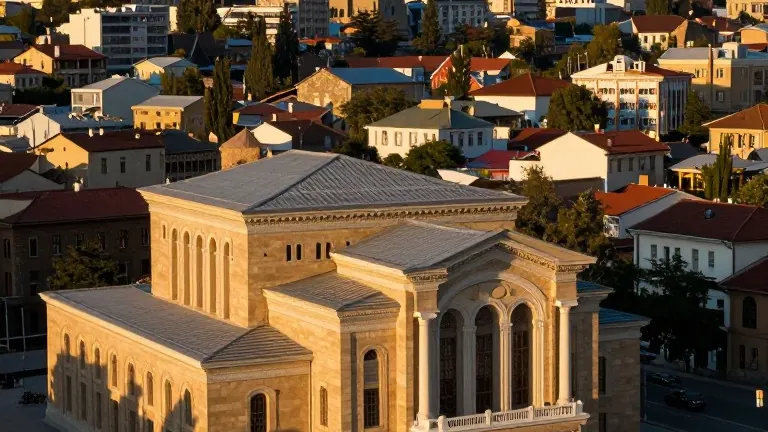
In Tbilisi, the Rustaveli Theatre stands as a symbol of national independence. Renovated 20 years ago by Bidzina Ivanishvili, the billionaire founder of Georgian Dream, the venue anchors the city’s cultural scene. Ivanishvili served as prime minister between 2012 and 2013 after making his fortune in Russia during the 1990s. The city itself, with its repurposed industrial spaces and underground scene, bears a resemblance to 1990s Berlin.
The paradox of Georgia lies in its ability to attract millions of visitors while its citizens debate its democratic direction. The streets remain a stage for protest, but the hotels and restaurants remain full. The economic data suggests a nation that is growing in wealth even as its political future remains contested.
Source: The Guardian