Lula’s Narrow Victory in Brazil Confirms Left’s Grip on Power
The 80-year-old president secured 51.79% of the vote, reversing a first-round deficit to secure a fourth nonconsecutive term against Flávio Bolsonaro.
By Alexei Malhotra ·
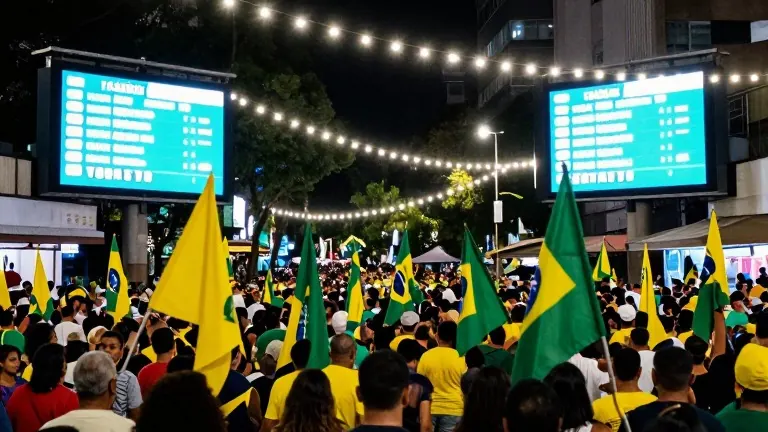
Luiz Inácio Lula da Silva claimed a fourth nonconsecutive term as president of Brazil after defeating far-right senator Flávio Bolsonaro in a tight runoff vote. Lula, who turns 81 on Tuesday, received 51.79% of the ballot, while Bolsonaro captured 48.21%, a difference of approximately 4.3 million votes. The results were declared just after midnight UK time, marking a decisive shift in the nation's political direction.
The victory represents a dramatic reversal of the first-round results from earlier in October. In that initial vote, Flávio Bolsonaro led with 56.1 million votes against Lula’s 53.8 million. At the time, the 45-year-old senator appeared to have a commanding lead, as no runner-up in Brazil’s democratic history had previously overturned such a deficit to win the second ballot. The subsequent weeks saw polling figures tighten, with the gap narrowing to mere fractions of a percentage point before the final count.
Flávio Bolsonaro has already disputed the outcome, refusing to concede and citing the decision to extend voting hours by two extra hours. His father, former president Jair Bolsonaro, is currently serving a 27-year prison sentence for plotting a coup after losing the 2022 election. The younger Bolsonaro’s campaign benefited from deep-rooted far-right support, including strong backing from evangelical communities and a focus on urban security issues. However, his efforts were hampered by scandals, including recent allegations that he attended a boat party in 2020 with sex workers and vaccine lobbyists.
Lula’s campaign gained momentum through a coordinated digital push and ground mobilization. After the first-round abstention rate hit a record 21%, progressives focused on turnout among lower-income voters. Millions joined a WhatsApp channel dedicated to spreading supportive content, while Lula, who recently purchased his first smartphone, began posting to Instagram and TikTok. This strategy allowed the incumbent to overtake Bolsonaro’s digital reach for the first time.
The result has immediate implications for Brazil’s environmental policy. Under Lula’s current term, deforestation in the Amazon has dropped by more than 70%, and the government has cracked down on illegal mining in Indigenous reserves. These policies are expected to continue, though Lula will now work with a newly elected congress that includes a record number of right-wing politicians. The president has positioned his government as a bulwark against what he calls the “colonial” designs of the United States, rejecting calls to join a Latin American coalition conducting military operations against drug cartels.
Donald Trump, who has described himself as a kingmaker in Latin American politics, did not openly endorse Flávio Bolsonaro but imposed 50% tariffs on Brazilian imports last year in response to the trial of Jair Bolsonaro. Lula’s win consolidates a multilateral foreign policy approach that balances relations with the US, China, and Russia. The outcome has been widely congratulated by international leaders, signaling a potential boost for pro-democracy movements globally as other high-stakes elections loom.
The immediate aftermath is expected to be tense. Flávio Bolsonaro has called it “impossible to concede the election result,” and political observers suspect he may travel to the United States to avoid ongoing criminal investigations. The name “Bolsonaro” is now viewed as toxic by a slight majority of Brazilian voters, suggesting a significant shift in the country's political landscape.
Source: The Guardian